


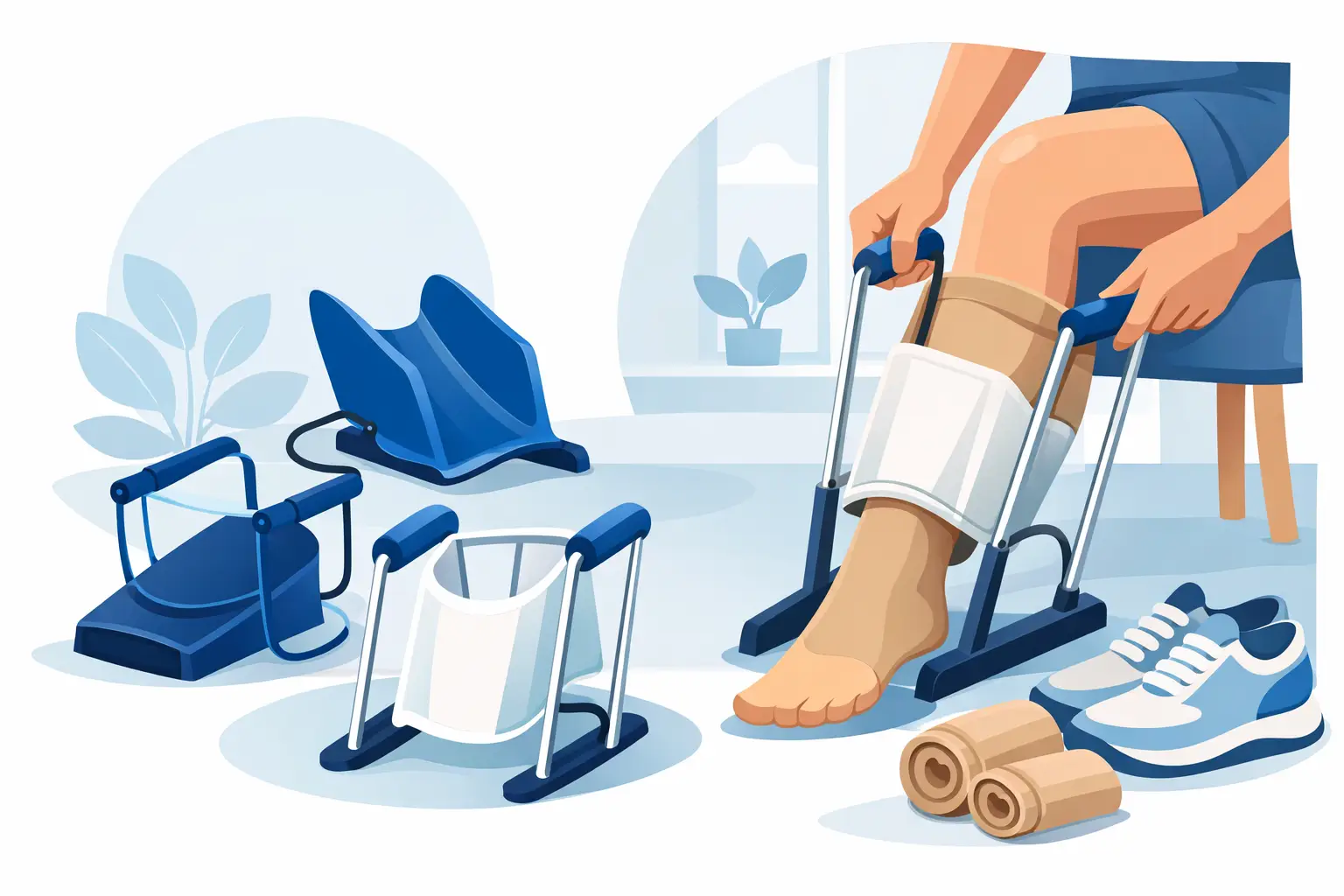
Compression stockings should fit evenly, must not dig into the skin, and need to be pulled up to the prescribed height. This can become a daily challenge for people with reduced hand strength, back problems, arthritis or those recovering from surgery. If you want to buy a donning aid for compression stockings, you should therefore consider more than just the price. The key factors are the type of stocking, compression class, the user’s mobility and the specific care situation.
The right donning aid reduces the effort required and helps you put on the stocking without damaging the material. This is particularly important because creases, twisting or uneven tension can compromise the effectiveness of medical compression. For many people, this aid offers one key benefit: the ability to incorporate compression therapy into their daily routine independently and reliably.
Why a donning aid is useful for compression stockings
Medical compression stockings apply a defined level of pressure to the leg. This pressure decreases from the bottom upwards and, depending on the doctor’s prescription, supports venous return. For the treatment to work as intended, the stocking must be put on correctly. With compression class II or higher in particular, people often do not have enough strength in their hands and fingers to manage this on their own.
A donning aid holds the stocking open as you pull it on or provides a smooth gliding surface between the foot, leg and material. This eliminates the need for difficult gripping, pulling and gradually working the stocking upwards. It reduces strain on the hands, shoulders and back—for both people putting on their own stockings and their family members or caregivers.
However, it is no substitute for having the stockings professionally fitted. If you experience pain, pressure marks, numbness or changes in your leg, have your compression garments checked promptly by a doctor, medical supply store or healthcare professional. Special medical guidance also applies in cases of open wounds, significant skin changes or arterial circulation problems.
Which donning aid is right for your compression garments?
Start with a simple question: Are you wearing knee-high or thigh-high stockings, tights, or models with an open toe? Not every donning aid is suitable for every type. Always check the product description and manufacturer’s information against your existing compression garments.
Frame-style donning aids for reduced hand strength
Frame-style donning aids usually consist of a sturdy, coated metal frame. The compression stocking is stretched over the frame so that the foot opening remains wide open. You then place your foot inside and pull the stocking over your heel and lower leg using the handles.
This type is particularly suitable for people with reduced grip strength or limited mobility in the hips or back, as well as those who find it difficult to bend forward. Long handles can further reduce the range of motion required. Look for a sufficiently wide, stable design that suits your foot and calf measurements.
However, a frame is less practical for travel and takes up space when stored. People with very muscular calves, those wearing thigh-high stockings or those with certain custom-made garments may need a special model.
Glide socks and sliding aids for open-toe stockings
Glide socks are pulled over the foot before putting on the compression stocking. They help the stocking slide more easily over the heel and instep. The gliding aid is then removed through the open toe. These products are lightweight, compact and well suited to travel.
They assume that the person can at least partially grip the stocking and position it on the leg. They are therefore not always the best choice for users with severely limited hand function. Classic glide socks often do not work with closed toes. Depending on the system, other donning or doffing aids may be suitable instead.
Donning aids with straps or cuffs
With strap and cuff systems, the stocking is guided over a smooth sleeve or a textile aid. Pull straps make it easier to pull the stocking up without having to tug directly on the delicate stocking material. Depending on the design, these systems are suitable for knee-high and thigh-high stockings, and sometimes also for compression tights.
Their advantages include flexible use and low weight. However, they require a little more practice than a rigid frame. Especially when starting a new treatment, it is worth taking time to practise putting the stocking on or asking a healthcare professional to explain how to use the aid.
What to look for when buying
Compression class is an important criterion when buying a compression stocking donning aid. The greater the pressure exerted by the stocking, the more stable and effective the aid should be when helping you put it on. A simple glide aid may be sufficient for light compression, while a frame with handles or a compatible system may be more suitable for stronger compression.
The type of stocking is also relevant. Open-toe and closed-toe stockings require different solutions. For thigh-high stockings, the donning aid must be long enough or designed to guide the material further up in a controlled way. For tights, it is also important to consider whether both legs can be put on one after the other and how easily the material can be smoothed over the hips.
Also consider the user’s physical abilities. Anyone who has difficulty standing needs an aid that can be used safely while seated. For people with hemiplegia, advanced osteoarthritis, Parkinson’s disease or those recovering from shoulder surgery, a model with long handles, a non-slip base and clear guidance can be particularly helpful. For home care, ease of cleaning, material durability and reliable handling by different caregivers are also important.
How to put the stocking on without damaging it
The skin should be dry. After applying cream, it is advisable to wait until it has been fully absorbed, as moisture makes the stocking harder to put on and can strain the fibres. Remove jewellery from your hands and wrists to avoid snagging threads. If needed, specially designed gloves with a textured surface can improve grip and help distribute the stocking evenly.
First, place the stocking on the donning aid according to the instructions. With a frame, position the heel in the designated spot before inserting the foot. Then slowly guide the material over the heel and calf without jerking. Do not pull on the top band. Instead, use flat hands to smooth the stocking upwards section by section.
Once the stocking is in place, smooth out any wrinkles from the bottom up. The heel must be correctly positioned, and the top band must not be folded over or rolled down. A constricting edge can cause discomfort. For open-toe stockings, check the toe area as well: the toes must not be squeezed and should remain free to move.
Donning aid, doffing aid or both?
Taking off medical compression stockings also requires considerable strength. Some users manage with the same aid, while others benefit from an additional doffing aid or gloves. Older stockings, warm skin or limited finger mobility can make taking them off much harder than expected.
Anyone who wears compression garments every day should consider the entire routine: putting them on in the morning, checking the fit, taking them off in the evening and caring for the stockings. A solution that only works for putting them on in the morning but makes taking them off difficult provides only partial support for independent living. For care facilities, standardised equipment that is easy to explain and use can also make workflows more efficient.
When to seek professional advice
Professional advice is particularly useful when getting compression garments for the first time, ordering made-to-measure stockings or if the stocking size is unclear. The same applies if the donning aid does not slide over the heel, the stocking wrinkles despite being used correctly or pain occurs. An unsuitable combination of stocking and aid can make daily therapy unnecessarily difficult.
At Servomed, users and professional buyers can find aids for compression therapy, as well as complementary products for mobility, care and everyday life at home. To make the right choice, carefully check the information about the stocking type, the required handle height and the intended use.
The best donning aid is one that can be used in the morning without rushing and puts the compression stocking smoothly and securely in the right position every day with as little effort as possible.

