


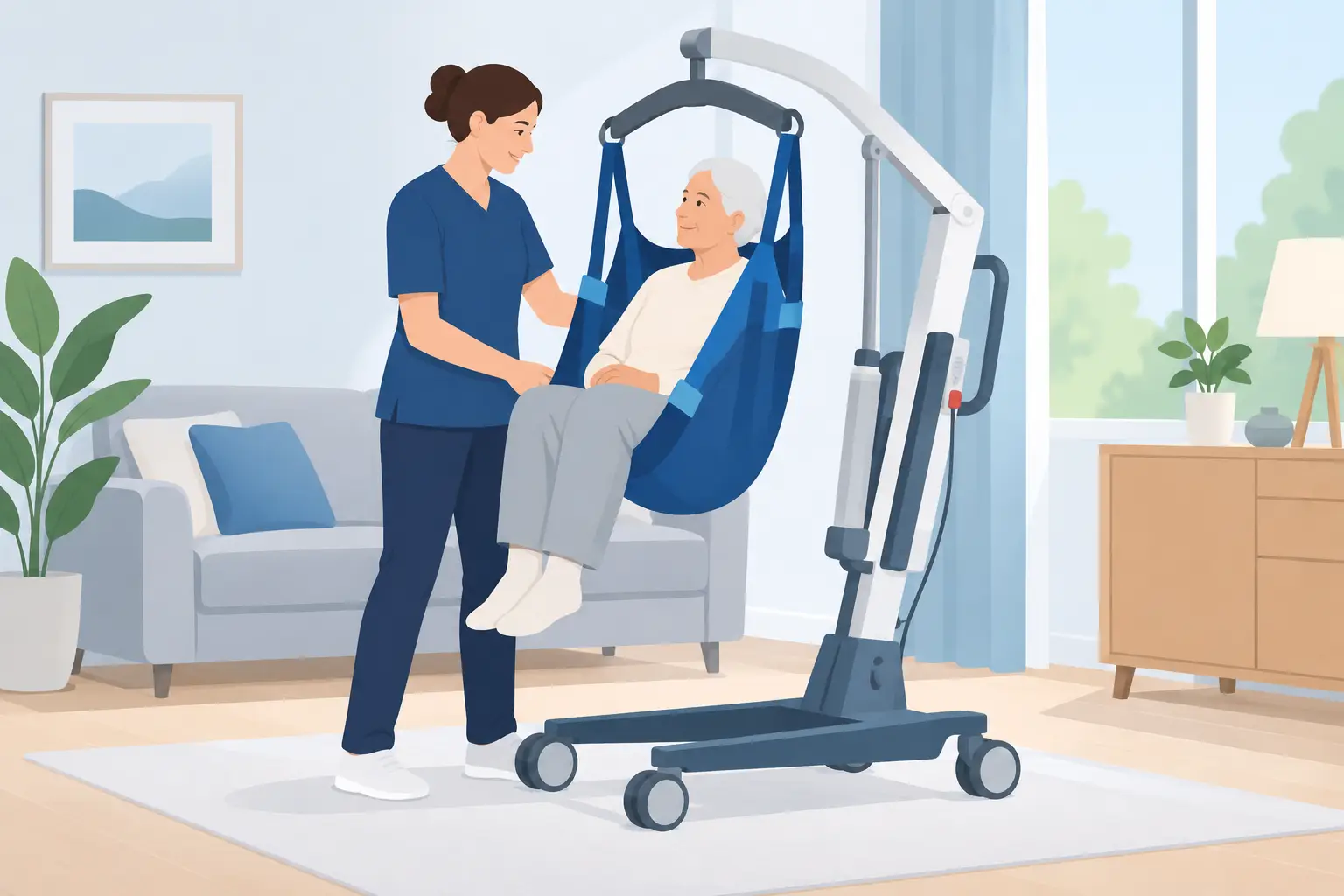
A transfer from bed to wheelchair can become a daily physical challenge for people requiring care and their caregivers. So, if you want to choose a patient lift for home care, you should consider more than just the price and weight capacity. The key is whether the assistive device suits the person’s mobility, the available space, and the recurring transfers involved in everyday care.
A correctly selected lift can help prevent falls and physical strain, support dignified mobility, and reduce the physical burden on caregivers. An unsuitable model, on the other hand, can create unsafe lifting situations or simply be impossible to use in a cramped bedroom.
Which patient lift suits the level of assistance required?
The most important question comes before choosing a product: Can the person receiving care still help safely, bear weight through their legs, and follow instructions? The answer determines the type of equipment needed.
A mobile patient lift with a wheeled base is designed for people who need to be transferred entirely or largely passively. It lifts the person using a sling and enables transfers, for example, from a bed to a wheelchair, commode chair, or suitable care chair. This type is often used when trunk and leg control are severely impaired.
A sit-to-stand lift, also called a standing or active lift, requires the person to retain sufficient function. They must be able to hold on to the handgrips, place their feet securely on the footplate, and bear at least some of their weight on their legs. It is suitable, for example, for transfers from bed to wheelchair or toilet when the person can still stand with assistance. If the person cannot bear weight while standing, a sit-to-stand lift is not a safe alternative to a passive patient lift.
Ceiling lifts are especially useful when transfers are regularly made between the same areas and a high level of assistance is needed over the long term. The rail system keeps the floor clear and makes it easier to move around in small rooms. However, installation must be planned in line with the building structure and carried out by qualified professionals. For temporary care or use in changing locations, a mobile lift is often more flexible.
Choosing a patient lift for home care: assessing weight capacity correctly
Maximum weight capacity is a safety specification, not a rough guide. It must reliably accommodate the actual body weight of the person receiving care. You should also allow for a sufficient safety margin, especially if a heavy sling, clothing, orthopedic aids, or other positioning elements are used.
The design of the lifting arm is also important. The maximum lifting height determines whether transfers from a care bed, a wheelchair with a higher backrest, or a low seat can be carried out easily. The base must have sufficient clearance if the lift needs to be positioned under a bed, chair, or wheelchair. Not all furniture provides enough floor clearance.
On mobile lifts, the spread of the base legs affects stability. Legs that spread wider can improve stability and make it easier to maneuver around a chair. At the same time, they take up more space. A model with large dimensions may be impractical in a narrow bathroom or between a bed and a wall. That is why measuring is part of the selection process: check door widths, turning space, clearance under the bed, and the distance to furniture before buying.
The right sling is essential for comfort and safety
The sling is not an interchangeable accessory, but a central part of the transfer system. It must suit the person’s body shape, the transfer destination and their individual sitting or trunk stability. A sling that is the wrong size can dig in, slip or cause an uncomfortable sense of insecurity.
Universal slings are often suitable for everyday bed-to-wheelchair transfers. For people with limited head and trunk control, models with a head support are generally the better choice. Toileting slings allow easier access to the intimate area, but provide less full-body support. They are only suitable if the person can sit with sufficient stability and the selected sling is approved for this purpose.
Check the size specified by the manufacturer and the compatible suspension systems. Loop, clip and spreader bar attachments cannot be combined arbitrarily. The sling and hoist should be used as a coordinated system. Professional advice is particularly useful in cases of sensitive skin, risk of pressure ulcers, contractures, spasticity or pain. In these cases, the choice of material, leg support or head support alone can make transfers considerably more comfortable.
Hygiene requirements must also suit everyday care routines. Washable slings make repeated use easier, provided the care instructions are followed. Higher hygiene standards apply in cases of infection, incontinence care or use by multiple people. A second sling may be useful to ensure a suitable transfer remains possible while the other one is being washed.
Check the actual transfer routine before buying
A patient hoist is not purchased for a single occasion, but for recurring routines. So make a note of when and where transfers take place: from the care bed to the wheelchair in the morning, to the toilet during the day, back to bed in the evening or to the shower area for personal care. The requirements vary considerably.
For toilet transfers, manoeuvrability, the opening function of the legs and the seat height of the destination surface are particularly relevant. Transfers from the floor after a fall have their own requirements. Not every standard hoist is suitable for lifting someone from the floor, and especially after a fall, it must first be established whether an injury may have occurred. If there is pain, misalignment, a change in consciousness or an unclear cause, do not attempt to move the person without professional assistance.
The person’s ability to assist may also vary throughout the day. After a neurological condition, or in cases of dementia, Parkinson’s disease or severe fatigue, their level of mobility is often inconsistent. A mobility aid must therefore be suitable for less favourable situations, not just for the best part of the day.
Safe use requires training and consistent procedures
A patient hoist does not replace proper transfer technique. Before first use, training should be provided by a qualified professional, for example as part of the provision of the mobility aid or by an outpatient care service. Family caregivers need to know how to fit the sling correctly, check the suspension and adjust the base width.
Before every transfer, check the brakes, battery charge, sling, loops or clips, and that the route is clear. The person must not be left unattended while being lifted. Calm communication is important during transfers: explain each step, ensure the person is as upright and comfortable as possible, and avoid unnecessary swinging movements.
The brakes are used according to the intended procedure. With many mobile patient lifts, the lift is not locked during raising, allowing the chassis to align beneath the center of gravity. The manufacturer’s instructions and the training provided for the specific model are always decisive. Personal habits or assumptions based on other devices can pose a safety risk.
Regular visual inspections are also essential. Damaged seams, frayed loops, tears in the sling material, unusual noises or restricted lifting functions must not be ignored. The device should not be used again until it has been inspected or repaired.
Consider costs, prescriptions and coverage
A patient lift may be prescribed as a medical aid when medically necessary. Whether and to what extent the health insurance fund covers the costs depends on the individual circumstances, the prescription and the applicable contractual terms. Other authorities may be responsible for nursing care aids or home adaptations in some cases.
Before purchasing, it is worth consulting the doctor’s office, a care advisory service, the health insurance fund or the long-term care insurance fund. A precise description of the transfer difficulties is helpful: Can the person no longer stand up safely? Is manual transferring no longer medically reasonable for family caregivers? Are several transfers needed each day? The more clearly the care needs are documented, the easier it is to identify a suitable aid.
If purchasing privately, remember to factor in not only the device but also lifting slings, batteries, the charger, maintenance and any spare parts. The availability of suitable accessories and wear parts is particularly important when the device is used on a regular basis. Servomed can help with a wide range of products for home care and professional care needs.
A good patient lift fits into everyday life without defining the person by their limitations. Take the time to check measurements and transfer scenarios and arrange professional instruction—then a technical aid can make a tangible difference for everyone involved.

