


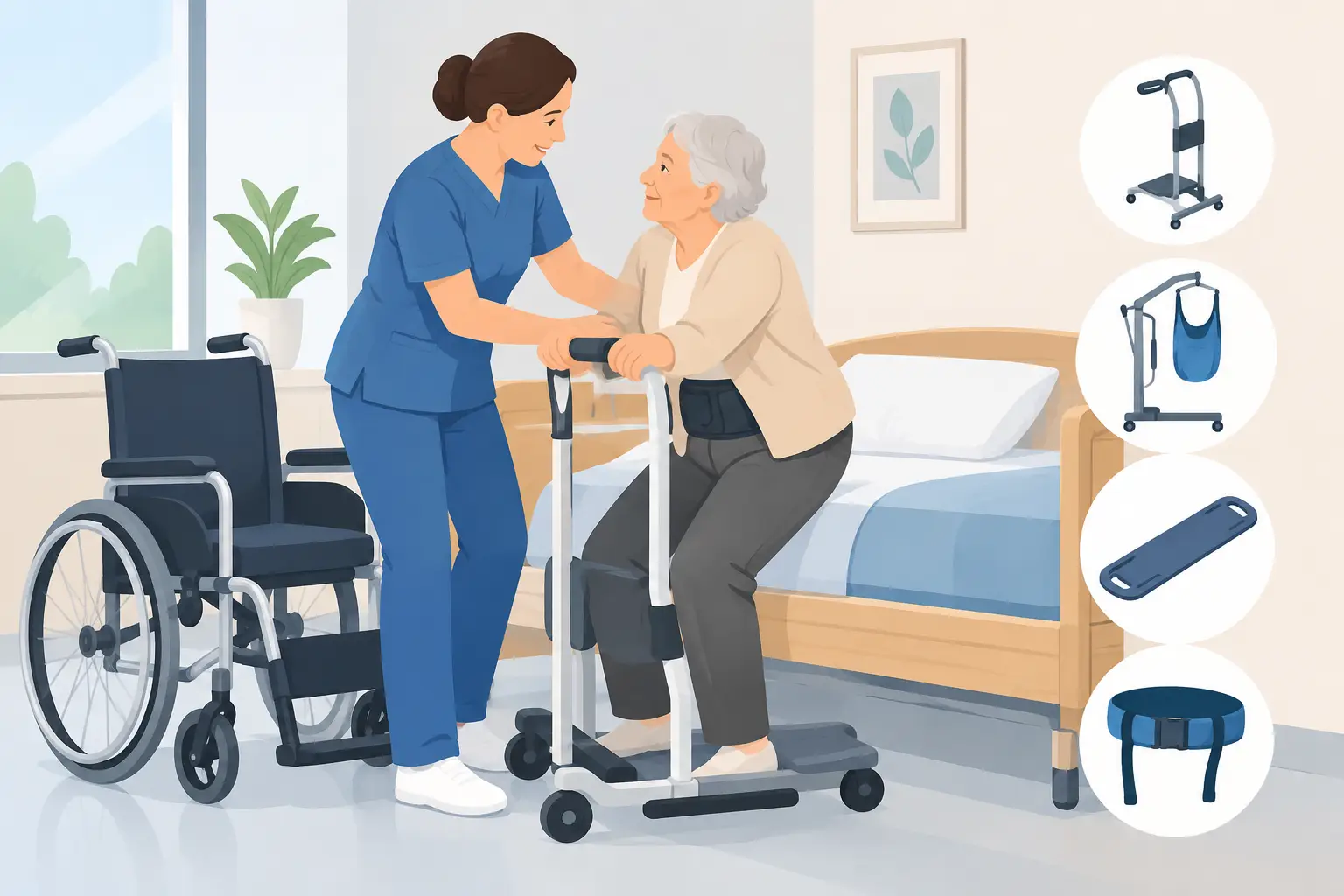
A transfer from a bed to a wheelchair, toilet or shower chair often determines whether a resident feels safe and respected during care. Transfer aids for nursing homes not only reduce physical strain on care staff. When selected appropriately, they support mobility, prevent falls and enable transfers tailored to each person’s actual support needs.
The key question is therefore not: Which transfer aid is best in general? What matters is which solution is suited to a person’s mobility, weight, trunk stability, cognitive status, day-to-day condition and surroundings. A facility usually needs several coordinated aids rather than a single device for every situation.
Why Transfer Aids Are Essential Equipment in Nursing Homes
Transfers are among the most physically demanding tasks in care. Moving a person, helping them to stand or transferring them between a bed, wheelchair and bathroom can place considerable strain on the back, shoulders and hands. Improvised lifting techniques or transfers without suitable support put both residents and staff at risk.
For residents, there is more at stake than simply moving from one place to another. A safe transfer can help preserve existing abilities: residents who can sit up at the edge of the bed with guidance, stand briefly or actively participate in a transfer experience a sense of independence and control. Conversely, an unsuitable aid can cause anxiety, worsen pain or lead to unnecessarily passive care.
Suitable aids also make a difference to day-to-day operations. Clear procedures, readily available equipment and trained staff prevent delays and last-minute workarounds. This is especially important for recurring transfers during morning care, trips to the toilet, after therapeutic interventions and for residents with high support needs.
Assess Support Needs Before Choosing a Product
Before purchasing equipment, every facility should systematically assess transfer needs. A diagnosis alone is not enough. Two people with similar conditions may have very different abilities and risks when transferring.
Key factors to assess include the ability to sit and stand, leg strength, trunk and head control, grip strength, as well as pain and contractures. Body weight and dimensions, skin condition, pressure ulcer risk, any catheters or drains, and the ability to understand and follow instructions must also be considered. If a person’s capacity fluctuates, for example after an infection or as a neurological condition progresses, their care needs must be reassessed regularly.
The transfer situation is equally important. Transfers between a bed and wheelchair have different requirements from those between a wheelchair and toilet. Small bathrooms, door thresholds, carpet edges, low beds or furniture that does not allow a device to fit underneath can limit the choice of an otherwise suitable aid. Safe working load, turning radius and clearance underneath furniture are therefore practical purchasing criteria, not minor details.
Transfer Aids Used in Nursing Homes
Transfer aids can be grouped according to the level of active participation they require. This classification helps ensure that an aid is viewed not as a substitute for care expertise, but as targeted support for a particular procedure.
Aids for Residents Who Are Mostly Independent
Transfer boards and turntables may be suitable when residents can sit safely, control their upper body and participate at least to some extent. A transfer board bridges small gaps between two seating surfaces. However, it requires good positioning and adequate protection against shear forces and skin damage, as uncontrolled sliding can put strain on the skin.
Turntables support transfers while standing, for example from a bed to a chair. They are only suitable if the person has sufficient standing ability and can partially bear weight. In cases of significant balance problems, inability to bear weight or unpredictable movements, they increase the risk of falls and are therefore not a safe alternative to a patient lift.
Standing aids for partially active transfers
Standing aids, often called stand-up lifts or standing lifts, support people who can hold on to handles and bear some of their weight through their legs. They are often suitable for short transfers and can encourage active participation. The leg supports, foot position and appropriate sling are crucial to prevent pressure on the knees, underarms or sensitive areas of skin.
A standing lift is not suitable for people who cannot participate safely, lack sufficient trunk stability or may suddenly buckle. In these cases, a passive patient lift is the safer choice. The team must clearly define this distinction so that the device is not used incorrectly under time pressure.
Patient lifts for full support
Mobile or ceiling-mounted patient lifts enable transfers for people with severely limited mobility. They significantly reduce the physical strain on caregivers and provide residents with controlled movement, provided the sling, seating position and lift are correctly matched. Ceiling track systems can offer advantages for frequent transfers or small, hard-to-access rooms, while mobile lifts can be used flexibly in multiple locations.
The sling is a safety-critical part of the system, not merely an accessory. It must be suitable for the person, the lift model and the intended use. Different designs may be required for transfers involving longer periods of sitting, toileting or residents with limited head control. Always follow the manufacturer’s approval and observe the permitted combinations of lift and sling.
Selection criteria for procurement and everyday care
Practical equipment is chosen to meet specific requirements, not by acquiring as many individual products as possible. When making a selection, facilities should formally check at least the following points:
- Safe working load and size range: The device’s maximum permitted weight, as well as the appropriate size and load capacity of the sling, must be documented.
- Transfer destination: Beds, care chairs, wheelchairs, toilets and shower chairs place different demands on the chassis, leg spread and positioning.
- Activity level: Transfer boards, turntables, standing lifts and passive lifts are not interchangeable. The person’s remaining mobility determines the appropriate category.
- Hygiene and reprocessing: Surfaces, padding and textiles must be suitable for cleaning and reprocessing in accordance with the facility’s hygiene standards.
- Operation and maintenance: Battery life, charging procedures, emergency lowering, spare parts and inspection intervals must be manageable within daily work routines.
For mobile lifts, you should also check whether the base can slide under the bed, armchair or shower chair. A lift with a high weight capacity is of little use if its legs do not fit under the existing furniture. The height of the lifting arm and the clearance of doorways should also be considered before purchase.
Safety depends on how equipment is used, not just on the technology
Even high-quality assistive equipment does not automatically prevent misuse. Every transfer aid requires clear instruction, defined responsibilities and regular practical refresher training. New employees, temporary staff and trainees must know which aids are approved for which residents and when a second care worker is required.
Before every transfer, check the brakes, battery, condition of the sling and the safe position of the bed, wheelchair or chair. When transferring a resident, explain what is happening and involve them actively wherever possible. This helps them feel oriented and makes it possible to identify pain, dizziness or uncertainty in good time.
Take particular care if the resident has recently developed pain, circulatory problems or acute confusion, has recently undergone surgery, or has experienced a change in their ability to bear weight. A procedure that was previously well established may no longer be appropriate for a time. The assessment of nursing professionals and, where necessary, consultation with a therapist or physician take priority over familiar routines.
Integrating transfer aids into a consistent care plan
For nursing homes, it makes sense to integrate transfer aids into repositioning, mobilisation and pressure ulcer prevention plans. Residents who are transferred safely can change position more often, take part in communal activities and make use of their existing mobility. At the same time, peak workloads for staff can be planned more effectively.
Clearly labelling equipment, providing suitable storage locations and keeping enough slings available all help avoid time spent searching. Facilities with several residential units can benefit from planning their inventory according to resident profiles and typical transfer routes. Allowance should also be made for spare capacity during repairs and laundry cycles, as well as for short-term increases in support needs.
Good transfer aids do not make care less personal. On the contrary, they provide the physical safety and peace of mind needed to give a resident attentive support when getting up, transferring or settling in.

