


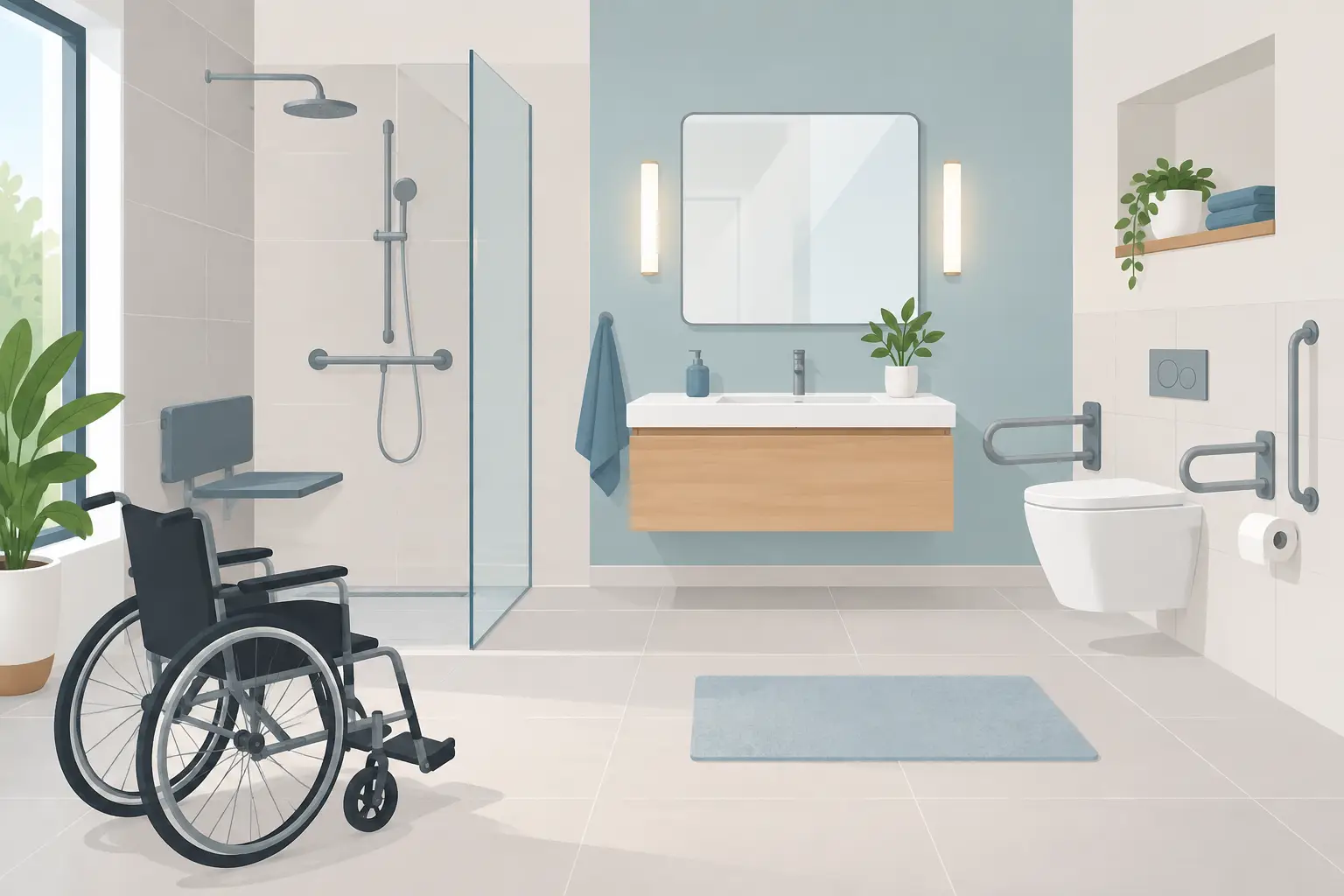
A wet bathroom floor, a high shower tray, or getting up from a low toilet can quickly become a fall risk in everyday life. This guide to accessible bathrooms explains which measures can promote safety and independence—whether a person has a long-term mobility impairment, is recovering from surgery, or receives help from family members with care at home.
A bathroom does not necessarily need to be completely renovated to make it accessible. The key is to consider the specific movements the person needs to make: How safely can they walk? Do they use a rollator, wheelchair, or walking aid? Do they need help washing, showering, or with intimate hygiene? The answers will help determine which structural adaptations and aids are appropriate.
Accessible bathrooms: safety starts with planning
Bathrooms combine limited space, smooth surfaces, and frequent changes of position. Anyone moving from a rollator to the toilet, sitting down in the shower, or leaning on the washbasin needs enough room to move and dependable grab points. Good planning not only reduces the risk of accidents but also makes transfers easier for family caregivers and care staff.
For a comprehensive renovation, the requirements of DIN 18040 can provide valuable guidance. Among other things, it distinguishes between areas that are accessible and those that can be used without restriction by wheelchair users. However, not every measurement can be achieved in an existing home. In that case, prioritize the main problem areas: access to the bathroom, the space in front of the toilet and washbasin, and the shower entrance.
Before starting work, it is advisable to assess the existing space carefully. Door width and swing, radiators, windows, pipes, and electrical outlets can significantly affect the options available. The user’s height, strength, balance, and ability to grip are also important. A grab bar, for example, is only helpful if it is installed at the right angle and reachable height, and on a wall that can support it.
The shower: level access, slip-resistant, and easy to reach
A level-access shower makes getting in easier because there is no threshold to step over. It is particularly beneficial for people with limited leg mobility, those recovering from hip or knee surgery, and people who use a shower wheelchair. The floor must slope sufficiently toward the drain to prevent water from spreading across the room. Slip-resistant flooring is just as important, as a modern-looking tile is not automatically suitable for a wet area.
For people who cannot stand safely, a shower stool or shower chair provides a stable place to sit. Models with a backrest and armrests offer additional support. A fold-down shower seat saves space in small bathrooms, but must be properly secured to a load-bearing wall. For people with greater support needs, a mobile shower and commode wheelchair can eliminate transfers and make personal care much easier.
The faucet should be reachable while seated. Thermostatic faucets help prevent scalding from water that is too hot. A hand shower with a long hose allows targeted washing while seated. Shower rails should not be used as grab bars without checking: they can only support weight if they are specifically designed for that purpose and installed accordingly.
Adapt the toilet and washbasin to the user’s mobility
Low toilets make it harder to stand up and place considerable strain on the hips, knees, and hands. A raised toilet seat can be a suitable short-term or long-term solution. It is available in various heights, sometimes with a lid or armrests. The right option depends on the seat height, the user’s mobility, and whether they need to transfer sideways.
Fold-up support rails beside the toilet provide support when sitting down and standing up. They are especially useful when a person has different levels of strength on each side or transfers from a wheelchair. Permanently mounted grab bars can be an alternative, but they also require suitable fixings. Suction grab bars are not designed to bear weight and should only be used as an additional aid, with their grip checked before every use.
A wheelchair-accessible washbasin provides legroom for wheelchair users and allows them to wash while seated. The mirror should extend down to a lower height or be tiltable. Single-lever taps are generally easier to operate than twist handles. For people with limited hand function, extended levers, touchless taps or easy-to-grip controls can make a real difference in everyday use.
Guide to accessible bathrooms: understanding measurements
Measurements are not a mere formality; they determine whether a bathroom can be used safely. There needs to be enough clear space in front of the toilet, washbasin and shower to turn a walker or position a wheelchair. A turning space of 150 x 150 centimetres is often used as a guideline for wheelchair accessibility. Even in smaller existing bathrooms, a well-thought-out layout can make a noticeable difference, for example by installing an outward-opening door or a sliding door.
The door also deserves attention. It should be wide enough to allow walking aids, shower wheelchairs or a wheelchair to pass through. Outward-opening doors prevent a person who has fallen from blocking the door from inside the bathroom. Where this is not structurally possible, a suitable emergency release mechanism may help. Thresholds at the entrance should be avoided or made as low and high-contrast as possible.
Contrasting colours help people with impaired vision find their way around. Clearly contrasting grab bars, an easy-to-see toilet seat and sufficient glare-free lighting are often more effective than purely decorative design. Motion sensors or easily accessible light switches eliminate the need to walk around in the dark. Lighting should also minimise reflections on wet surfaces.
Aids for renovation periods and everyday needs
Not every care need has to wait until a bathroom renovation is complete. There are aids for many situations that can be used without major structural changes. However, they are no substitute for a safe bathroom layout when there is a high risk of falling or extensive assistance is needed.
A bath board or bath seat makes it easier to get into the bath and wash if the bathtub is to remain in place for now. However, transferring over the edge of the bath may already be unsafe for people with severely limited mobility. In that case, a different shower solution is generally more suitable in the long term. Non-slip mats can provide extra support, but they must lie flat, be easy to clean and not create a tripping hazard themselves.
For washing at the basin or in the shower, long-handled bathing aids, easy-to-use soap dispensers and ample storage space are useful. Caregivers benefit from a working environment that reduces the need for close lifting. A shower wheelchair, a suitable transfer aid or a height-adjustable care stool can provide lasting relief for the back and shoulders.
Continence care should also be organised discreetly and hygienically as part of bathroom planning. Incontinence products, skin protection and cleansing supplies should be stored within easy reach without restricting movement areas. A waste bin with an easy-to-use lid and an accessible towel rail help maintain a hygienic routine.
Funding and professional advice
Where there is a medical need, certain aids may be eligible for prescription. Whether statutory health or long-term care insurance covers the costs depends on the specific aid, the care level, the prescription and the individual care situation. Under certain conditions, structural adaptations may be subsidised by long-term care insurance as measures to improve the home environment.
It is therefore worth consulting a medical practice, therapist, care advisor or qualified specialist company before buying or renovating. Grab bars, shower seats and transfer aids in particular must be suitable in terms of weight capacity, installation and seating position. With its wide range of bathroom and care aids, Servomed can help put together a selection suited to individual needs.
A well-planned bathroom does more than make life more comfortable. It gives people the opportunity to continue carrying out familiar routines independently for longer—and makes care safer where it happens every day: at home.

